Spoiler Alert

**Plot points will be discussed**

Monday, June 14, 2010

The Bluest Eye, by: Toni Morrison

Blaming others for situations allows people to feel better about themselves. Toni Morrison’s novel, The Bluest Eye, depicts acts of misplaced blame that cast its characters into a cycle of cultural repression. In her novel, Morrison provides background information on characters that have committed acts of rage and frustration in such a way as to provide an explanation and understanding for why these characters behave the way they do. Morrison provides scapegoats for her characters to foster the understanding that these black people, suffering from racism, are stuck in a cycle of hegemony, where they are placing blame on other black people, when they should be looking outward to the white community that is keeping them oppressed.

The first character, Cholly, neglects his family, is often drunk, abuses his wife, and rapes and impregnates his daughter. Cholly’s story chronologically begins, “When Cholly was four days old, his mother wrapped him in two blankets and one newspaper and placed him on a junk heap by the railroad” (132). Thankfully, Cholly is rescued by his Great Aunt Jimmy. She raises him until her own death when he is fourteen years old. On the day of her funeral Cholly experiences the devastating embarrassment of being caught by two white men during his first act of sexual intimacy.

Their [Cholly and Darlene] bodies began to make sense to him…There stood two white men…The snicker was a long asthmatic cough…The flashlight man lifted his gun down from his shoulder, and Cholly heard the clop of metal. He dropped back to his knees…Darlene put her hands over her face as Cholly began to simulate what had gone on before. He could do no more than make-believe…Cholly, moving faster, looked at Darlene. He hated her. He almost wished he could do it—hard, long, and painfully, he hated her so much. (147-8).

In this moment the line between love and tenderness blends with lust and anger for Cholly. He loses all sense of what passionate intimacy can be, because he will forever carry this image of his first experience with it blemished by these horrible men. Furthermore, Cholly does not blame the men, but Darlene, making her out to be another woman who has put him in harm’s way. It is no wonder why Cholly is so abusive later in life.

Secondly, Pauline, is frustrated with her life as a mother and wife. Pauline is a house keeper in a white family’s home. She has created a world of make-believe where she pretends that the nice home and good family is her own, rather than her employers. Pauline grew up wanting more for her life. Her family moved to Kentucky because they heard about the work in mines and millhouses. While she was growing up she lived in a “real town…with water piped right into the kitchen…a five-room frame house for their family. The yard was bounded by a once-white fence which Pauline’s mother planted flowers and within which they kept a few chickens” (112). This was a comfortable living for Pauline, a living she expected to make for herself one day. She ended up with prostitutes living above her second floor, two room apartment, with four children and a drunken husband. One day, while Pauline is working she leaves her daughter in the kitchen to retrieve laundry for her to carry home. While her daughter is in the kitchen she accidently knocks down a hot berry pie that burns the girl’s leg badly. The daughter of Pauline’s employer is also in the kitchen, and when Pauline returns she beats her own daughter for making a mess and then comforts the other girl for being worked up over the commotion. The backwardness of the situation is nearly outrageous. Pauline has such high regard for the pretend world that she has created, that when her own child is suffering she only adds to the pain.

Morrison is making a statement in her novel. She is saying that regardless of the white racists that oppress and control the black community, it is that community that is keeping itself repressed. The characters in this novel are not blaming the right people, they are looking at their friends, their family, but they do not stop and look at the cause of all their anguish. The cultural hegemony expressed in this novel is displayed through all of its characters, including Cholly and Pauline. The couple does not take the time to evaluate why they feel the way they do. If they did they may be surprised to learn that the people and situations they are blaming for their misfortunes in life are simply bystanders to the cultural oppression occurring in their lives.


Monday, May 24, 2010

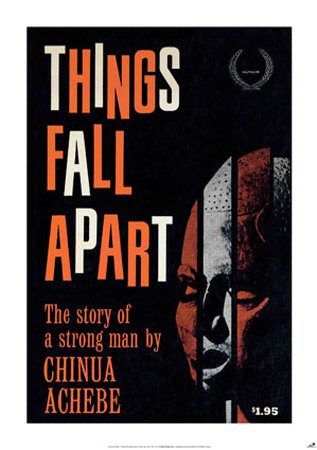
Things Fall Apart: Initial Response


Author: Chinua Achebe
Original Copyright: 1959 Length: 209 pages Time to Read: approx. 2 Weeks Verdict: Smart Read,Liked It
I think I'm still digesting this one.

More than half of the novel felt devoid of plot. There was just a compilation of events in this man's life. A list of horrible things that happened to him, until the middle of Part 2, when you begin to see the person vs. society conflict emerge between Okonkwo and the Christian Evangelists. Though, perhaps, in this case, that is okay.

This is a novel length story that simply deals with the way that one man lived. It is the highlights of all that happened to a warrior leading up to his final battle.

Achebe may have achieved something that no other author I've ever read was been capable; he
held my interest through 142 pages of exposition. I am not convinced that I needed all the information that was provided about Okonkwo. I believe that a few pages explaining his life would have been sufficient to describe who he was, and his culture. I do not feel more empathetic for him because I have more details about his life. If anything, I may feel less.

In the 142 pages that I am viewing as exposition, I see a man who is prideful and harsh. A man who does not want to learn to be better, as long as he feels respected within the community. He follows the rules set by his society, and because he willingly accepts his punishments they revere him, put him high on a pedestal, even. Yet to my eye he does not do anything to deserve such praise.

The saying goes "to err is human, to forgive divine." Okonkwo errs on many occasion, does his penitence and then is forgiven by his society. Is it not the society who then should receive the praise that they so lavishly bestow upon their "great warrior?"

If making mistakes is human nature, then learning from them is growth. Okonkwo repeats his mistake several times, expecting that things will be different. The very definition of stupidity. How can anyone look to this man and say he is great?

As a reader can we forgive him time and again for allowing his pride to get in his way, because he repents? Is saying you are sorry enough? Are words now speaking louder than actions?

So why? Why tell a story about a flat character? The final question, answered so eloquently on the final page.

This is a novel length story about a man's life, but not the man you thought.

On the last page of this novel, Things Fall Apart, must turn to, "Things Fall Apart," for we learn that it is only one section from the larger work titled The Pacification of the Primitive Tribes of the Lower Niger. A work written by the District Commissioner, sent by his Queen to convert Africa to the one true religion.

On the final page of the novel, we learn, or least believe, that we have just read a novel narrated by a man who desperately wants to discredit Okonkwo, his family, and his tribe; to make them look like the prideful, stubborn, wrathful, uncivilized peoples that they have just appeared to be.

While reading Things Fall Apart the reader compiles a list of events that have occurred in Okonkwo's life that have literally fallen apart. His father's short-comings, the death of many children, the manslaughter of young woman, banishment, his son's conversion, his own imprisonment, and his choice to murder the white messenger. What we are unable to consider until the very end of this novel is that things do not fall apart for Okonkwo, things fall apart for us.

The tone of the novel was one of high-browed condescension. As a reader I felt that I knew better than Okonkwo, because that is what the narrator wanted me to believe.

Achebe did a very powerful thing as a writer, he gave the reader a chance to use their intellect to pass judgment. How can I believe that Okonkwo was a foolish man after finishing this novel, when the words of his closet friend echo in my mind?

"That man was one of the greatest men in Umuofia. You drove him to kill himself; and now he will be buried like a dog..."

These words combined with the realization that the narrator was coming from an unreliable perspective forced me to reconsider every moment of the novel. Every page of exposition.


Sunday, May 23, 2010

Welcome

Hello, and welcome to my very first posting.
Let me begin by introducing myself. I'm a twenty-something, New Jerseyian, recent college graduate holding a degree in secondary education and English, Creative Writing.
I'm currently applying for positions in the real world.
While all that is in progress, I'm going to finally find time for the activity that got me interested in my degree program...READING.
I'm going to read many different books over the coming weeks, and write about them here. I'm open to suggestions and discussions.
Hopefully I do some more of that thing called learning.
At times I feel like a bad English major, who really hasn't read very much.
Perhaps this post-graduation activity will be the thing I need to feel more accomplished in the literary community. Anyway, time to begin!